I first met Graham over 25 years ago while serving in the British Army. I can remember the exact time, conversation and location when we first met. I'd just been posted into a new unit as the regiment's Army Physical Training Instructor. One of my junior PTIs said, "I'll introduce you to Captain Graham Markham, you'll like him." His prediction was spot on. Graham became one of my most trusted and loyal friends, and later my best man.
But who'd have thought that 25 years later, Graham, now 66, and I, at 53, would set out to bikepack unsupported across Iceland?
Graham and I have a yearly bikepacking pilgrimage, so I was thinking about what we could do that was a little different from the safe Spanish environment. I'd looked at Romania and the Atlas Mountains as possible locations, but I wanted something more challenging. A few searches later I discovered a route called the Iceland Divide. This immediately got my attention.
We needed a much bigger challenge, not just in the type of riding, but also in the style of being truly self-supported for days in much more challenging conditions. Graham and I have lost count of how many times we've been out on exercise in really tough weather conditions. We'd have friends say, "Haven't you had enough of being cold and wet?" That's part of the challenge. Being cold and wet isn't a pleasant experience, but if you have your shit in a sock, it's much more manageable. So even at 66 and 53 years old, we were still looking to be tested in this unpredictable environment.
The end of August looked like a good weather window, but even in August the weather is unpredictable and can be severe. This meant we needed to research, prepare and get the right kit: a new tent, a new sleeping system, and a plan for how best to carry the extra weight on our gravel bikes. It turned out our bikes and kit weighed around 40kg to 45kg fully loaded. This was our first experience riding with this kind of load, so we were moving kit around almost every day, then forgetting where we'd put it!
There is a classic North-to-South Iceland Divide route which starts at Akureyri and finishes at Vík, but we wanted to ride back to Reykjavik as part of our journey, so we headed south-west after day four. The Iceland Divide is a route that runs either south to north, or north to south. Depending on the route you choose, the distance and elevation will vary, but generally you're looking at around 400 to 500km, with 4,000m to 5,000m of elevation.
What I will say from the very start is that the gravel conditions are far from perfect. It's rough, gnarly, corrugated, with long sections of sand. This is important for appreciating the time it takes and how you plan your legs each day. And I've not even mentioned the weather, specifically the wind.
I didn't want to be too ambitious with this ride — Graham is 66. I didn't want to be chasing kilometres only to be left totally exhausted and without the time to really appreciate the surroundings. So we planned for an average of around 70km per day. This may not sound like a lot, but your average speed will be around 10 km/h. Why? The bikes are very heavy, the gravel is very tough, and then you have the wind.
While I was learning to be a canoe instructor in the military, I learnt the technique of the "short-stop camp". This is what the early European pioneers did in North America before setting out into the wilderness in a 12-man canoe. Graham and I did the same as we set off from Akureyri. We rode 15km out of town and set up a wild camp.
The next morning the weather was on our side: clear blue skies, with a gentle tailwind to push us up the valley to start the 800m climb. For the first 40km, you're lulled into a false sense of security. You're riding on tarmac, farmhouses dotted around, with the odd vehicle driving past you. However, this feeling of security would soon disappear.
The early part of the route was exactly like riding through the Scottish Highlands: green rolling hills, hardy sheep, with small tributaries leading into the river we were hand-railing. At 40km, we stopped to rest and to dry our tents out after a heavy frost that night. We didn't want to set up our first "real" wild camp with wet tents. This is a tip I'd strongly suggest if you plan to do this kind of adventure. Graham and I would schedule our daily tent-drying stop with breakfast and coffee.
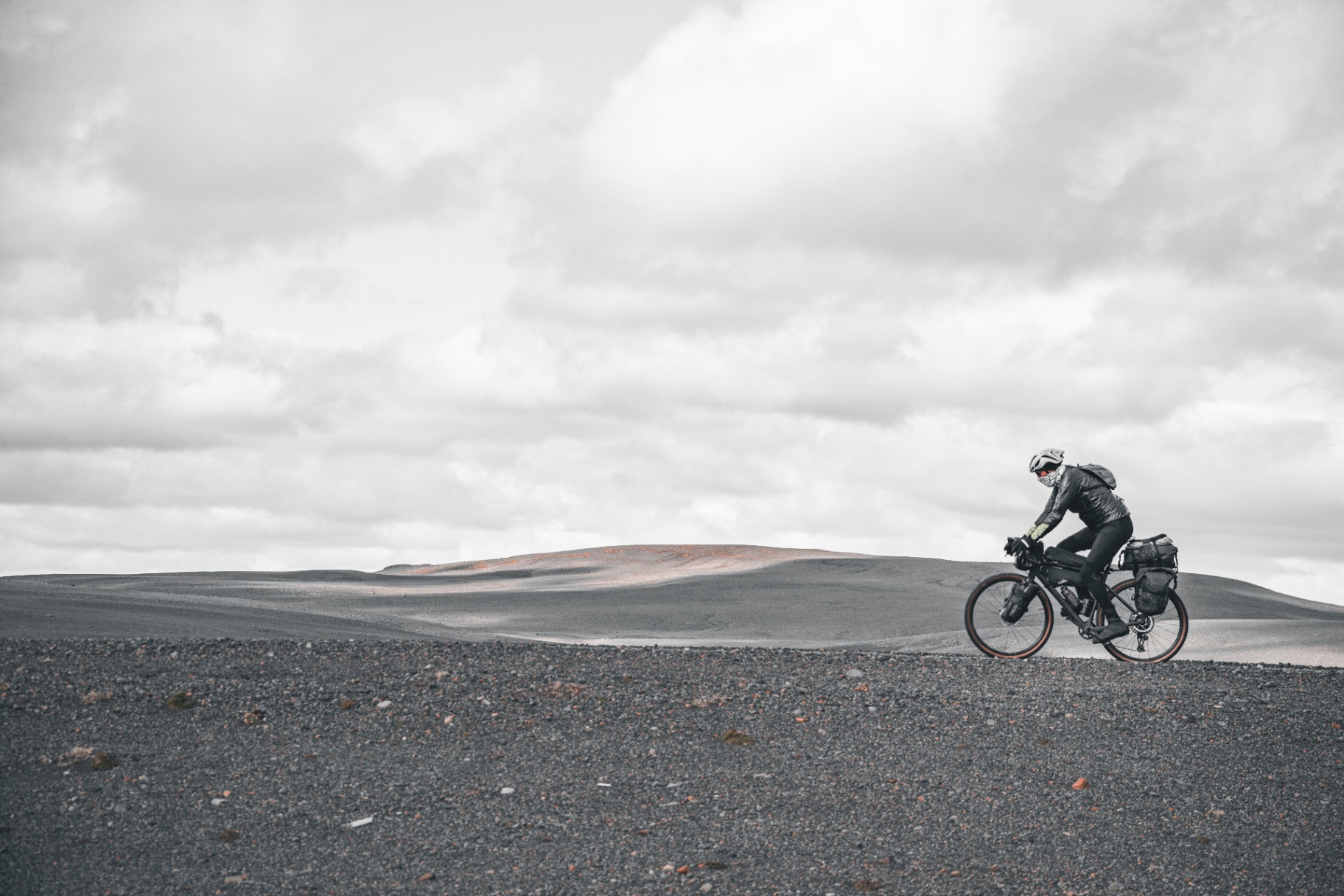
The climb gets steep — far too steep to ride the last section — so, like any bikepacking adventure, you're hike-a-biking. And, as with all summits, this one didn't disappoint, with at least three false summits. What struck me immediately when we topped out was how the scenery changed. No more green, lush hills and rivers, just grey, bleak, endless wilderness as far as the eye could see. It was at this point that I had a slight sense of foreboding and excitement in equal measure. Looking out at the vast gravel road ahead was intimidating, but at the same time I felt exhilarated that we'd be heading out into the interior of the island with just what we were carrying.
From a distance, the road looked like Champagne gravel; however, I'd describe it more like home-brew gravel. The roads are not maintained at all, battered by extreme weather conditions, off-road vehicles, wind and ice, so the surface is far from smooth. I'd describe it like trying to ride over hundreds of golf-ball-sized rocks, with the odd cricket-ball-sized rock thrown in for good measure.
With a heavily loaded bike, riding this type of ground takes constant concentration. Your bike suddenly has the reaction time of a sloth and the turning circle of a P&O ferry. It was slow going, but it was our first day and the roads would surely improve over time — right?
The first campsite was quickly located and set up behind a low berm that offered little protection from the wind. There was no real cover, but we were close to a water source. We were now working against the clock to set up, eat and wash before the weather turned nasty. This was now the real test of our equipment: would our tents protect us, keep us warm and dry during the heavy rain and wind that was forecast in just a few hours?
During my Army days, while out on exercise, I would feel a sense of satisfaction sheltering under a poncho and hearing the rain. My first wild camp took me back 30 years, lying in my tent feeling warm, dry and confident that my kit would do its job well.
I'd gone for a single-man tunnel tent, pretty lightweight, but it comes with a downside. Very little space to do admin, and there is a much higher chance of hitting the inner lining, which would form condensation. So although the tent kept me dry and warm, I did have to be alert not to touch the inner layer or my kit would get wet. I was specifically paranoid about keeping my sleeping bag dry.
I was thankful for my military training in this harsh environment, and one tip I would offer is the "wet and dry drill". This was a practice that was stamped into me during my Commando course many years ago. This drill is all about keeping your sleeping clothes dry and clean, while using your outer clothing for daily use. The idea is to never cross-contaminate your kit. This is best practice for anyone thinking about undertaking an adventure like this.
After our first real wild camp in tough conditions, our confidence was galvanised as we quickly fell back into discipline mode. This was also the Rubicon moment. We'd sort of passed the point of no return. We were now fully committed, no turning back.
The next few days crossing the flatter, higher section went well. We had the Nordic gods' favour, with a gentle tailwind. The only real struggle was the gravel; it never really allowed you to sit back, look up and relax.
This part of the journey wasn't spectacularly beautiful, more surreal. It was like riding on the surface of the moon. The only impressive thing to really appreciate was the Langjökull glacier, which was absolutely huge. I thought it was the sky. What I did notice was the lack of colour, just a grey expanse of desert.
After three days of riding, you're pretty much in the centre of the island. This was the most vulnerable and exposed I felt for the whole journey. So when a white 4x4 vehicle appeared on the horizon and drove towards us, it gave me a sense of security, even more so when the driver stopped and asked us if we needed anything.
I asked him for a flat white, much to his astonishment. After he realised I was taking the piss, Noah jumped out of the vehicle and, before I knew it, he'd presented me and Graham with a full box of cereal bars. "Take as many as you like," was his command. So we did — four bars each.
Noah was quickly joined by Lindsey, a young couple from New York, and they both thought we were crazy as shit to be riding across Iceland. We chatted and swapped a few stories about our experiences. They were heading to a hot spring which we had missed earlier that morning.
That interaction had a profound effect on me, so much so that after we'd finished our ride, I left them a voice message to thank them for their simple but very kind act of stopping to make sure we were both OK.
We met more people along the way, other riders coming from the south and a number of walkers who were doing the Divide by foot. Now that is batshit crazy. We'd always stop, shoot the shit a little, swap contacts, and I'd take a few photos to send to them later. Meeting like-minded people from all corners of the world was an added bonus.
Earlier in our ride, we purposely took a shorter route which meant we missed some hot springs, so on night three we decided to stop at the Landmannalaugar hot springs, which took us on a slight detour, but it was worth it. The official campsite is well equipped, so we took the opportunity to supplement our food and to enjoy the hot springs. Although the hot springs were a unique experience and something we needed to experience while in Iceland, it was a bit of a shock to see so many people there with vehicles.
This is where the scenery started to significantly change: more mountains, lakes and colour. Instead of the gruelling vast grey expanses from the first three days, you were now excited to see what was around the next corner or hill. This area was still barren, but you could see life starting to establish in the extreme environment. The volcanic rock was black, and you could see where the hot lava flows had stopped, with a blanket of soft green moss and small flowers taking hold. I now understand why Ridley Scott filmed Prometheus there; it was surreal to ride through this prehistoric environment.
The ride wasn't all plain sailing. After day three, I was experiencing some minor issues with my GRX Di2 gearing. For some bizarre reason, it would go into crash mode. The protocol to reset is relatively simple; you just go through the rear mech gears until it finds itself again. But this wasn't working as it should. I had no choice but to keep riding and hope it would eventually burst into life.
After 30 minutes, the system would burst into life and I was back in the game. However, this problem never really resolved itself. When I'd stop for just 10 minutes, it would go into crash mode. I had to be mindful to put my bike into a gear that I could realistically ride for the next couple of days. On the final day, I had to ride 60km with just two gears. Far from ideal, but manageable. This situation wasn't catastrophic, but being so far away from any help certainly focused the mind.
Being self-sufficient and having tools and spares at your disposal is important. It's easy to tell yourself you won't need certain tools you'd normally take on a training ride. Graham and I had a tool and kit amnesty before we headed out. It didn't make sense to carry duplicate tools and spares.
Some of the spares I'd recommend are: chain splitter, mushroom plugs for tubeless tyres, tyre boot, sealant and a solar panel. I also carried an electric pump that doubled up as a power bank. This pump was perfect for this type of ride. Changing tyre pressures to suit the ground conditions was essential to avoid punctures, snapping a spoke or damaging your carrying systems.
My only other minor issue was that my front fork bag mount had fallen off the bike. Due to the severity of the gravel, the bolts worked loose. Luckily, Graham and I had plenty of spare bolts to fix this efficiently and quickly.
At the start of day five we were 140km from Reykjavik, and we kept our plan flexible. If the wind was favourable we could ride this all in one day, but we also gave ourselves the option to wild camp again and not feel pressure to race to the finish. We had all the food and water we needed, and we had planned to do it in seven days.
Two things I would definitely be mindful of are to be conservative with how much distance you plan to cover each day.
The weather will ultimately dictate what you can and can't do. We were incredibly lucky on this ride, with a tailwind for almost the entire journey and just one night of heavy rainfall.
Be flexible with the route. Don't fall into the trap of thinking, "This is the route we planned, so we must stick to it." We changed route at least four to five times, taking advice from rangers and locals about possible hazards ahead, specifically river crossings. This won't undermine your adventure; on the contrary, it adds to the unknown outcomes and keeps you focused.
The key question you need to be able to answer is: can I survive out there for another two to three days without any support? If the answer is yes, then you don't need to panic or race the route. It enables you to relax and enjoy the journey.
It became even more apparent how important a strong friendship needs to be when riding across Iceland and sharing an adventure like this with Graham. There were points of high stress and anxiety, so knowing how to read the room was important. Graham and I continuously rinsed each other with unfiltered banter that only a strong relationship can endure. But we both had points during the ride where genuine advice, guidance and support were needed, and this adventure has only strengthened our friendship even further.